

Minimal Flavor Protection for TeV-scale New Physics
A reflection on the latest results: arXiv preprint 2512.04159.
The allowed flavor structure of new physics at the TeV scale remains one of the central theoretical questions in particle physics. It is also pragmatic, with direct implications for ongoing and future colliders. We’ve long known that flavor interactions must be structured (not anarchic), otherwise indirect effects in flavor-changing neutral currents or electric dipole moments would have already shown up.
The gold standard has been Minimal Flavor Violation (hep-ph/0207036): new physics respects the maximal SM flavor symmetry, broken only by the SM Yukawas. This makes TeV-scale dynamics essentially flavor-sterile and neatly evades constraints. A major next step was the minimally broken U(2)^5 flavor symmetry (1105.2296). By separating the third family, it allows richer flavor violation in b-quarks and tau-leptons. With the surge of heavy-flavor data, this became a key framework for interpretation in the past decade.
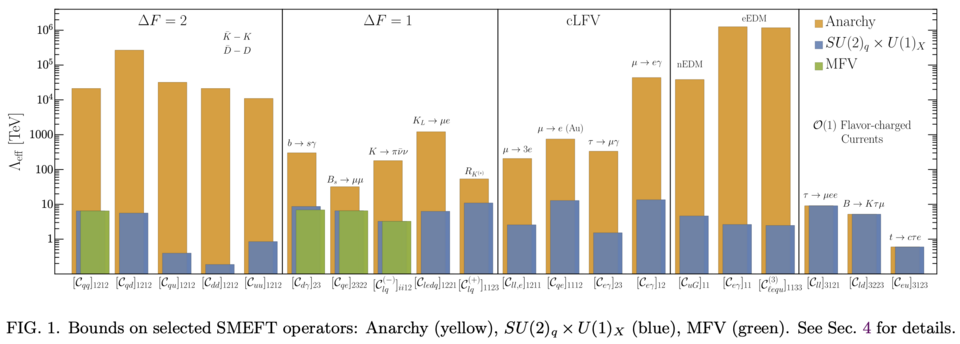
Now comes our new paper (2512.04159): we ask what the smallest approximate flavor symmetry must be to satisfy only the most dangerous constraints, such as Kaon mixing. Surprisingly, a much smaller rank-2 subgroup already provides enough flavor protection. This new theoretical framework, "Minimal Flavor Protection," offers two main advantages: (i) it allows significantly richer patterns of TeV-scale flavor violation, and (ii) it provides a foundation for understanding all flavor hierarchies.
As such, it becomes a new toolkit for TeV-scale physics: whether in SMEFT, simplified models, or more elaborate frameworks like the MSSM, composite Higgs, or WIMP scenarios. It gives a broader, more flexible language for interpreting current and future flavor-physics experiments.